Your sprint doesn't fail at delivery. It fails at the spec.
50% of sprints fail because of vague tickets. SprintGuard is a Jira Cloud app that intercepts them at creation auto-scoring quality, posting structured fix feedback, and moving weak tickets to backlog before a developer ever opens one.
30-day free trial · No credit card · Works with Jira Cloud · 1-min setup
Works inside Jira Cloud today · More integrations on the roadmap
23 words detected. Minimum 50 required for sprint readiness.
No Given/When/Then blocks found. Add at least 3 testable criteria.
Estimation required before sprint entry. Suggested: 5 pts based on similar tickets.
frontend, checkout — correctly assigned.
PROJ-2851 passed quality gate
2s agoScore 87/100 — Sprint ready. No action needed.
PROJ-2849 blocked for 3 days
12m agoDependency on PROJ-2840 unresolved. Flagged for review.
The hardest part of software engineering isn't writing the code.
It's deciphering vague requirements, hunting for lost context, and turning half-baked tickets into working software.
SprintGuard is a Jira Cloud app that sits inside your backlog, silently enforcing ticket quality at the source, so your team only ever works from specs worth shipping. No new tools. Just better Jira.

Baraa Abuzaid
Founder · Former Jira Engineer, Atlassian
I watched countless sprints derail Not because of bad code, but because of vague tickets and lost context.
SprintGuard is the governance tool I always wished we had while building Jira. A gatekeeper that stops garbage specs at the source, so developers can just build.
One automated review. Zero ambiguity.
SprintGuard posts a single structured analysis on every ticket, a Quality Score, actionable fix feedback, and automatic backlog triage.
Architecture strategy & IDE-ready prompts Coming Soon

commented on PROJ-2847 · 4s ago
Expand to 50+ words. Include user context, expected behavior, and edge cases.
Add 3+ Given/When/Then blocks covering the happy path, error state, and a boundary case.
Estimate effort. Suggested: 5 pts based on similar checkout tickets.
frontend, checkout — correctly assigned. No action needed.
- ▸Use Saga orchestrator for multi-step payment → inventory → confirmation flow
- ▸Event store gives full audit trail critical for checkout compliance
- ▸CQRS read model for fast cart state queries without blocking writes
- ▸Stripe webhook idempotency keys prevent duplicate charges on retry
"Scaffold a NestJS checkout microservice using Event Sourcing with a BullMQ Saga orchestrator. Include: Stripe webhook handler with idempotency, CQRS read model for cart state, event replay for audit trail, and dead letter queue for failed payment events. Use strict TypeScript, Repository pattern, and structured logging."
See it running inside your Jira project.
No new tab. No new login. It's already in the ticket.
Engineers are drowning in tools. SprintGuard doesn't add one it makes Jira work the way your best engineer always wished it did.
Semantic Analysis & Auto-Triage
Failing tickets receive a detailed analysis comment. Quality score, issues found, and specific recommendations then get auto-triaged to Backlog.
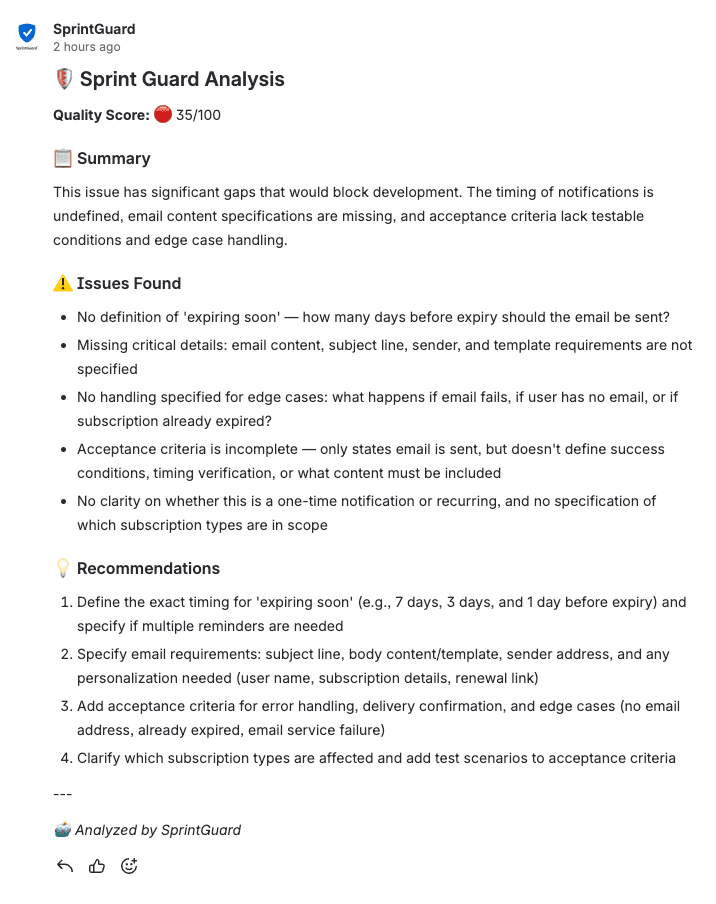
PHOENIX-767 blocked from sprint
just nowQuality score 34/100 auto-moved to Backlog.
Identify Edge Cases Instantly
The Health Check panel scores Clarity, Scope, and Quality in real-time and surfaces improvement tips directly on the ticket.
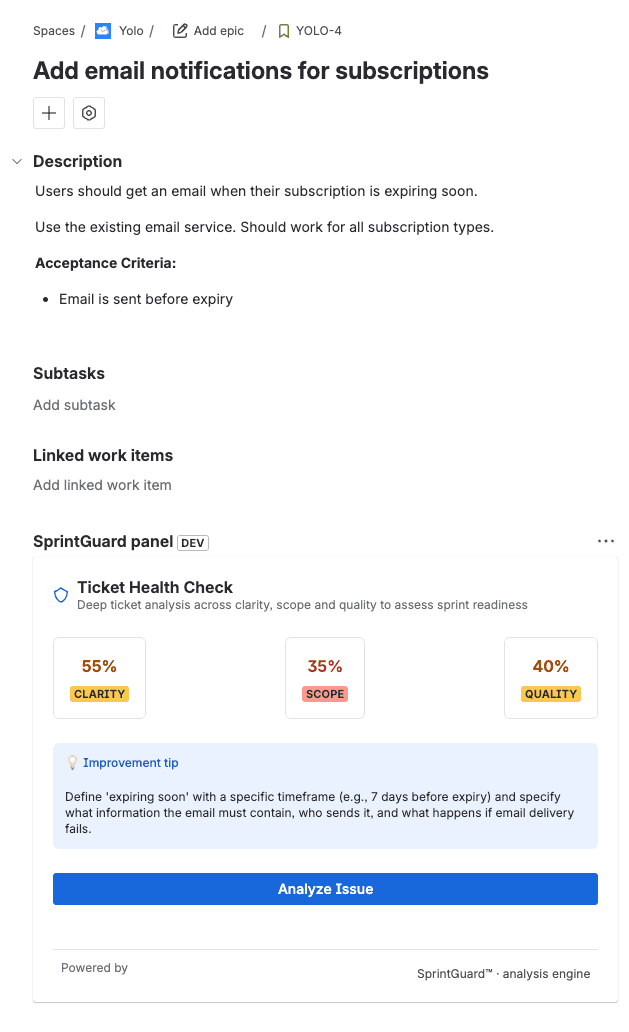
YOLO-04 blocked from sprint
12m agoQuality score 34/100 vague scope detected. Moved to Backlog with feedback.
Protect Sprint Velocity
Sprint planning should take 30 minutes. Bad specs are what make it take 3 hours. SprintGuard removes them before you open the board.
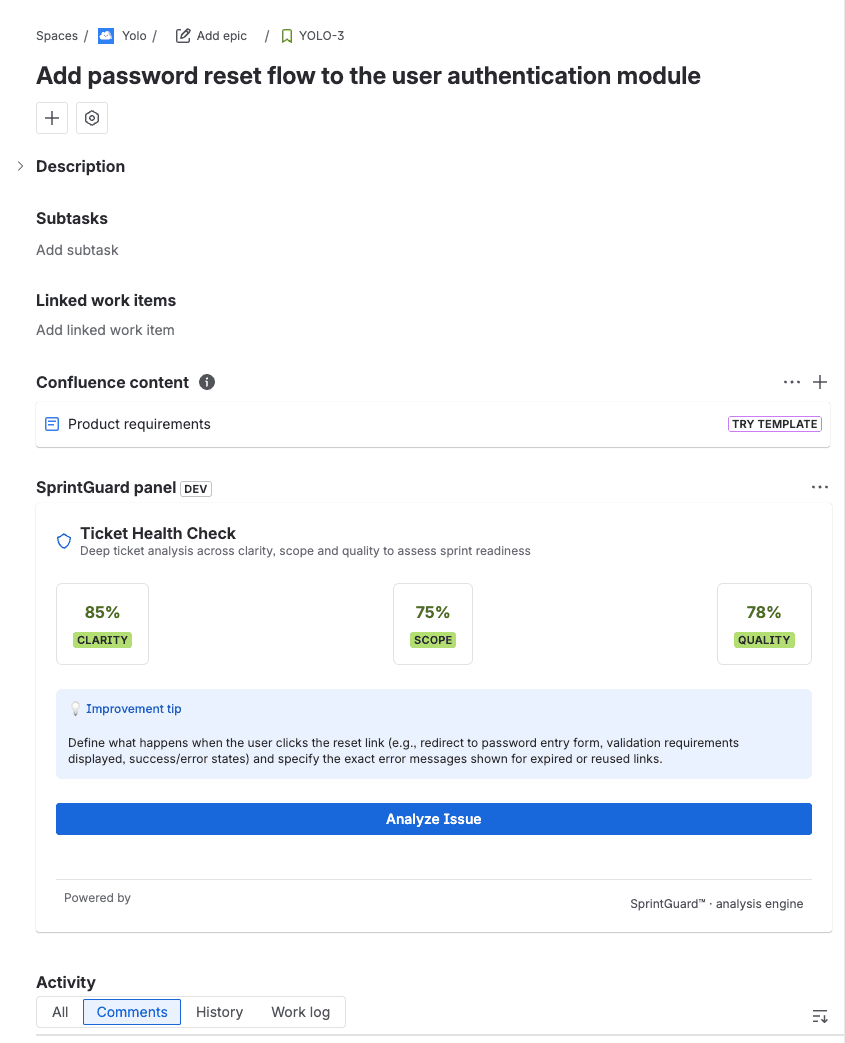
YOLO-03 is sprint-ready
2s agoScore 78/100 — Sprint ready. Improvement tips attached.
What SprintGuard Does
Silent protection. Zero friction.
SprintGuard runs three autonomous agents inside your Jira project, each one purpose-built to eliminate a different class of sprint failure.
Silently auto-detects weak specs, transitions them to the backlog, and leaves actionable Quality Score feedback.
Every ticket created in your sprint is instantly analyzed against your team's quality rules. Vague descriptions, missing acceptance criteria, and unestimated work are caught before anyone starts coding. Failing tickets are quietly moved to Backlog with a detailed breakdown attached.
Actively monitors the sprint to auto-detect and flag stalled or blocked tickets.
SprintGuard will continuously watch ticket status changes, dependency chains, and time-in-status. When a ticket stalls or gets silently blocked by an unresolved dependency, it surfaces the problem before your standup does.
Delivers full architecture reviews and outputs an optimised prompt that eliminates AI context loss.
For complex tickets, SprintGuard will produce a full architectural review, comparing implementation approaches, highlighting trade-offs, and generating a ready-to-paste prompt so your team goes from ticket to working code in seconds.
- ●Microservice with dedicated payment queue
- ●Retry logic via BullMQ with exponential backoff
- ●Idempotency keys on every transaction
- ●Monolith with saga pattern
- ●Database-level transaction locking
- ●Event sourcing for audit trail
"Scaffold a NestJS payment microservice with BullMQ queue, Stripe webhook handler, idempotency middleware, and retry logic with exponential backoff..."
From ticket to code. Fully automated.
SprintGuard runs as a silent loop inside Jira intercepting, scoring, gating, and guiding, so your team never ships from a broken spec again.
Install in Jira cloud
Add SprintGuard to your Jira Cloud instance. One click from the Atlassian Marketplace, no config files, no CLI.
Tickets Are Intercepted
The moment a ticket is created, SprintGuard activates. The Semantic Quality Engine benchmarks it against what separates a shippable spec from a sprint killer. In under 2 seconds.
Bad Specs Are Gated
Failing tickets are auto-transitioned to Backlog with a Quality Score and actionable feedback written directly to the issue. Your developers never see a garbage spec.
You Just Build
The Jira panel shows a "Fix It" view on flagged tickets. Authors improve and resubmit. Meanwhile, The Architect generates implementation prompts for your IDE.

Your next sprint deserves a quality gate.
Built by a former Atlassian engineer, battle-tested against the same ticket chaos that derails real teams. 30-day free trial, no credit card.